

From the middle to the end of the nineteenth century, the landscape of American domestic architecture was a kaleidoscope of revivals of European historic styles. Gothic Revival, Italianate, Tuscan Villa, Second Empire, Queen Anne, and even Egyptian Revival houses were being built around the country. Out of this cacophony a new, uniquely American style emerged: the Shingle Style.


It is important to remember that in the mid-nineteenth century, houses were generally designed by craftsmen and builders rather than architects. It was not until 1846 that an American, Richard Morris Hunt, formally studied architecture at the École des Beaux Arts. He was followed in the 1860s by Henry Hobson Richardson, only the second American to study at the École. Slowly, the profession of architecture was developing in America.
At the same time, awareness and knowledge of America’s historic architecture was also growing. In 1876 the Centennial celebrations refocused the eyes of architects on America’s colonial traditions. The following year Charles Follen McKim, William Bigelow, and Stanford White took their “celebrated” trip through New England making sketches and measured drawings of colonial houses.
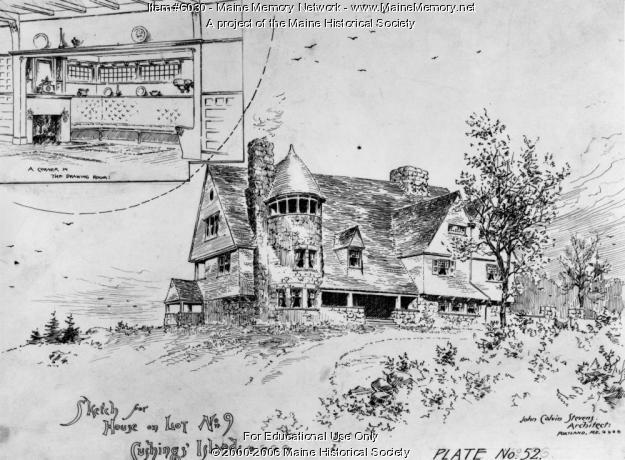

In the last decades of the nineteenth century, architects such as H. H. Richardson and Bruce Price, and firms such as McKim, Mead, & White as well as Peabody & Stearns took influences from rural England, Richard Norman Shaw’s Queen Anne style architecture, the open planning and massing in Richardsonian Romanesque work, and blended that with the American colonial tradition of wood frame buildings to create the Shingle Style.


Generally, the Shingle style is characterized by open floor plans; low, horizontal massing; dominating gable or gambrel roofs; and a taut skin of shingles curving around corners, sweeping across surfaces. Volumes of rooms perceptually push out of the skin of the building in bay windows, towers and porches. On the exterior, trim elements are lightly scaled, painted Indian Red, Olive Green or brown, and classical motifs appear in porch columns, windows, and doors. Rambling along, relaxed and informal, with great rooms for entertaining and broad porches for relaxing, Shingle Style houses were well suited to the carefree summers that wealthy industrialists spent in places such as Newport, Maine, Cape Cod or Long Island.


The Shingle Style is a style which develops from various cultural forces and architectural influences. Working in the common American material of wood, reinterpreting what they considered to be our only historic American architecture, that of colonial New England, and reacting to the unstudied Victorian revival styles, this early generation of trained architects created a new style which architectural historian Vincent Scully called “a mode of building…which was specifically American.” In his 1955 book, The Shingle Style and the Stick Style: Architectural Theory and Design from Richardson to the Origins of Wright, Scully coined the term Shingle Style and inspired a new generation of architects who continue to work in the Shingle Style today.


Copyright for all images and text, unless in the public domain or otherwise noted, Christine G. H. Franck, Inc.